Tuesday, August 2, 2016

Chapter 5: The Critical Path

You should always have an explicit traction goal you're working toward, which will depend on your current traction goal. That goal should directly align with your current business strategy.

Questions to Find Traction Goal

  • Are you aiming for growth or profitability?
  • If you need to raise money in X months, what traction is needed to get there?

These are the types of questions to ask to define your traction goal.

Work backwards to set goals (make sure they'll trackable), and set on the same calendar as other milestones to keep traction goals on the schedule aligned with product development.

The Critical Path

The path with the least number of steps to reach your traction goal is the Critical Path. Every step enumerated should be absolutely necessary to reach the traction goal.

Each milestone reached should trigger a re-assessment and potential re-alignment to maintain the critical path.

More than anything, the Critical Path will tell you what not to do.

Overcome Bias

In viewing the traction channels, make sure to spend a fair amount of time on each strategy and not overlook something. It's possible that your competitors might've done the same and that provides an opportunity to use that strategy to your advantage.

Key Points

  • Lay out your milestones
  • Stay on the Critical Path
  • Actively work to overcome your traction channel biases

Chapter 4: Traction Testing

On Middle Ring Tests

Goal: Find a promising channel strategy to focus on.

Important Questions to Test

  1. How much does it cost to acquire each customer through this channel strategy?
  2. How many customers are available through this channel strategy?
  3. Are the customers you are getting through this channel the ones you want right now?

Remember, optimizing a channel strategy is a full time endeavor, don't worry about that just yet. Middle ring tests arm you with the data you need to compare channel strategies.

Inner Ring Tests

Designed to do two things:

  1. Optimize your chosen strategy to maximize its usage.
  2. Uncover better channel strategies within this traction channel.

This takes a good bit of time, and should be used only after you have proof the strategy will pay off!

You should be continually, scientifically testing your channel strategy in an effort to increase its effectiveness.

Try using A/B testing.

Tools for testing:

The Law of Shitty Click-Throughs

"Over time, all marketing strategies result in shitty click-through rates." - Andrew Chen

Eventually, all strategies will wane and therefore, must be continuously monitored. The way around this is to brainstorm new ways to use this channel. You may even employ other strategies to boost your core strategy. Facebook ads for a blog post, etc.

More Tools for testing:

Tracking Analytics

At a minimum, include:

  • How many customer are available?
  • Conversion Rate
  • Cost to Acquire Customer
  • Lifetime Value of a Customer

Key Points:

  • Look for customers where others are not looking
  • Constantly Optimize
  • Keep it numerical

Thursday, July 21, 2016

Additional Resource

Special Thanks to Lee Todd, who forwarded this after last night's meeting.

This is a site called TractionStack.com that outlines the material from the book and provides a wonderful resource for anyone looking to employ the tactics therein.

http://tractionstack.com/

Wednesday, July 20, 2016

Traction: Notes from the first few chapters.

Notes from the first few chapters:

Must Haves:

  • Concrete Traction Goal
    • If an app, increasing download rate
    • If a subscription service, increasing monthly revenue
  • Build Something Testable
  • Divide Efforts Evenly
    • 50% Product Development
    • 50% Marketing/Traction

Also Read: Ryan Holiday, "Trust Me I'm Lying"

Goals:

  • Either get enough users to become profitable,
  • or... get enough users to attract investors.

Use AngelList to find out who's getting investment capital, and by what metrics they are receiving funds.

Phases to Growth

  • Phase I: Make what they want - Create a product with users
  • Phase II: Market to a core user base
  • Phase III: Scale

The Bullseye Method

  • The Outer Ring
    • For each channel, choose one channel strategy that can move the needle
    • Indentify the best channel strategy in each channel
  • The Middle Ring (~1 month testing time)
    • Promote no more than 3 best strategies to middle ring
    • Run a cheap test for each strategy
    • Each strategy should answer 3 questions:
      • 1. What is the cost/customer of this strategy?
      • 2. What is the total # customers available with this strategy?
      • 3. Does this strategy provide the customers we need NOW?
    • DO NOT SCALE...yet
    • Keep it small. 2 vs 10 ads on Facebook, etc.
  • Notes on middle ring testing
    • Only do 10-20% of efforts. 2 ads vs 10, etc.
    • Save A/B testing for Inner Ring
    • Don't even start til tracking/reporting mechanisms are in place
    • Tracking Metrics: Customer LifeTime Value, Customer Acquisition Cost, Conversion Rate, Click Thru Rate, # Customers Available, etc.
  • The Inner Ring - THE CORE CHANNEL!
    • Choose the most promising strategy from the Middle Ring (most resultant!)
    • Continuously experiment in this strategy to optimize growth
    • Keep and eye on saturation of strategy; cost per customer
    • Only choose one! No matter how tempting to diversify

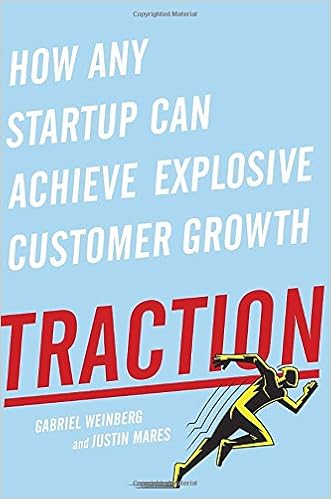
First Read: Traction